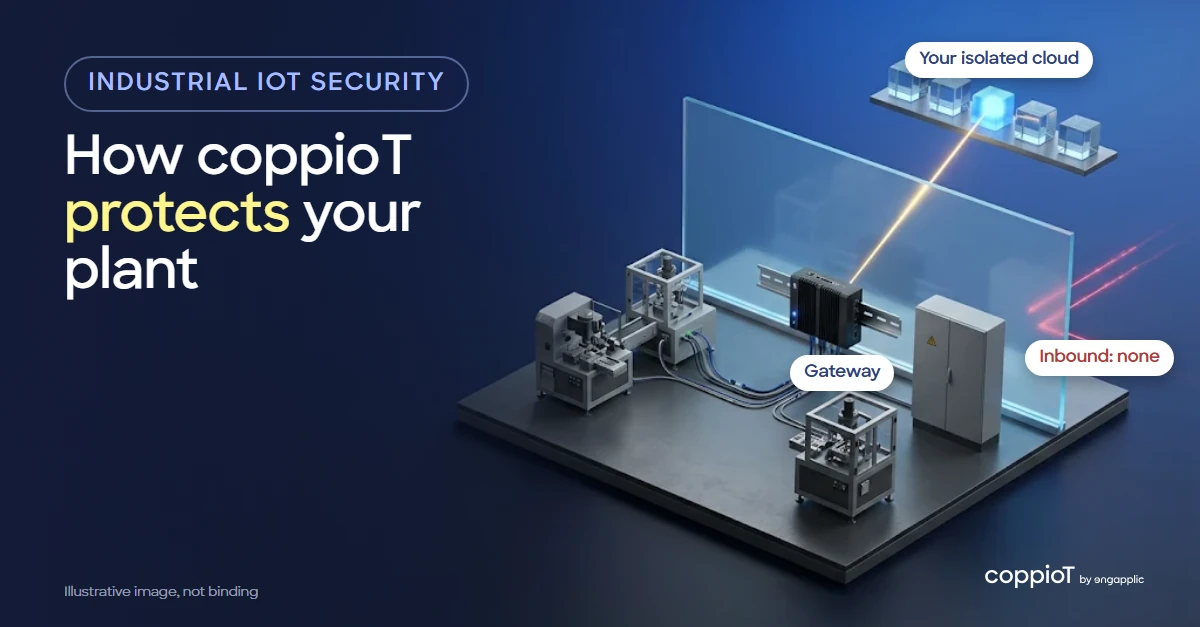
coppioT keeps a plant secure by letting nothing connect in. The gateway at the site only opens outbound, encrypted connections, proves who it is with its own certificate, and sends the readings to an isolated cloud environment that coppioT creates for each customer, in the region you choose. There is no inbound port to open, and no web page or password on the gateway to attack.
coppioT is engapplic’s no-code industrial IoT platform: it brings the data of a plant’s machines to the cloud. This article answers the IIoT security questions a plant’s IT and OT security teams ask before letting it in, starting with the attack that put those questions on every plant manager’s desk.
What happened in the French supermarket refrigeration attack?
On the night of 11 October 2026, attackers took control of the refrigeration controllers of some 700 French supermarkets, in chains such as Carrefour, E.Leclerc and Intermarché. They stretched the defrost cycles from one hour to as many as eight, which delayed the temperature alarms. Food had to be thrown away and, according to the Paris prosecutor’s office, the attack also caused fires (SecurityWeek).
France’s CERT-FR named the equipment: Danfoss AK-SM and AK-SC controllers, then Copeland and Dixell XWEB systems. Its alert doesn’t tie the attack to a specific flaw, but it is clear about what made it possible: “exposing a management interface on the internet is, in general, contrary to good practice” (CERTFR-2026-ALE-012). Danfoss added that most of the affected units were older models that no longer receive security updates.
How does coppioT keep the IoT gateway secure?
The attack needed a door: a web page on the controller that anyone on the internet could reach. A plant connected with coppioT doesn’t get that door, because of how the connection is built.
- Nothing connects in. The coppioT gateway, software that runs on any PC or Raspberry Pi at the site, only opens outbound connections. The plant’s firewall stays closed to the outside: no port forwarding and no remote-access tool.
- No web page and no password on the gateway. There is no login screen to find and no default password to try.
- A certificate for each gateway. Each gateway proves who it is with its own X.509 certificate, over mutual TLS. Reinstalling or deleting a gateway in coppioT deactivates and deletes its certificate, so a gateway that is replaced or stolen can no longer connect.
- No cloud keys on site. The gateway exchanges its certificate for short-lived credentials when it needs them. No long-lived cloud keys are stored on the PC.
- An isolated environment for each customer. coppioT creates an isolated cloud environment (a sandbox) for each customer, on AWS, in the region you choose for each project. One customer’s gateways can’t reach another customer’s data.
None of this makes a plant impossible to attack, and nobody should promise that. It means the path used in France doesn’t exist in coppioT.
What doesn’t coppioT protect? OT security beyond the gateway
coppioT protects the connection it adds, not the equipment already in the plant. If a controller, a SCADA or a maintenance service has its own web page open to the internet, it stays exposed after coppioT is installed. CERT-FR’s advice applies to all of them:
- Take management interfaces off the internet.
- Allow remote access only through a secure VPN or a protected network. Filtering source IP addresses is an emergency measure, not a lasting one.
- Update the firmware and change the default passwords.
- Check the settings an attacker could have changed: in France, the defrost ranges.
Which firewall ports does the gateway need?
| Direction | From | To | Ports |
|---|---|---|---|
| Outbound | The gateway | AWS, in the project’s region | 443, 8883 (MQTT) and 8443 |
| Outbound, while installing | The gateway | The gateway’s container image (ghcr.io) and AWS’s root certificate | 443 |
| Inbound | — | — | None |
The gateway sits on the same network as the machines it reads, and talks to them over OPC UA (see Modbus TCP vs OPC-UA). It never needs to be reachable from outside.
How is the data encrypted, and where is it stored?
- On its way to the cloud: from the gateway, over mutual TLS; from the browser to app.coppiot.com, over HTTPS (TLS 1.2 or 1.3).
- Between the gateway and the machines: coppioT supports OPC UA’s Sign and SignAndEncrypt security modes, with policies such as Basic256Sha256, and signs in to the server anonymously or with a user and password.
- Where it’s stored: the readings go to the customer’s isolated environment, in the AWS region you choose for each project, such as Frankfurt in the EU. The coppioT app, with the plant model and the users, runs in Amsterdam.
Access control: roles, API keys and AI assistants
- Four roles. A Viewer sees everything and changes nothing; an Operator works in projects; an Admin also manages projects, deployments, members and keys; an Owner manages the organization.
- Sign-in with a password or a passkey.
- API keys that expire (from 30 days to a year), can be revoked at once and never get more rights than the person who made them.
- AI assistants work with the user’s role. coppioT can be run from an AI assistant such as Claude: you ask it to add a machine and it does, as the person who connected it and with their role. Changes made through the API or an assistant are kept in the activity log for 30 days.
How are updates handled?
- The gateway is updated remotely, when you decide. You choose the new version on the gateway’s page in coppioT. Nothing changes on the plant’s PCs by surprise.
- The cloud services that receive the data, AWS IoT Core and AWS IoT SiteWise, are managed services that AWS keeps up to date.
To see the whole path from the machine to the cloud, read how to connect legacy machinery to the cloud.
Frequently asked questions
Is IoT secure?
It depends on how the connection is built, in a factory more than anywhere. An IIoT setup where nothing connects in, each gateway has its own certificate and every customer’s data is isolated removes the most common way in: a device reachable from the internet.
What does an IoT system need to be secure?
Whatever the platform, check these IoT security basics: no inbound ports open to the internet, its own identity for each device (a certificate, not a shared password), encryption all the way to the cloud, each customer’s data isolated, roles and API keys that expire, and updates you control. A gateway that only connects out also means no firewall port to open.
Can coppioT change my PLC program?
Today coppioT reads the values you configure and doesn’t change the PLC program.
Where is my data stored?
In an isolated cloud environment that coppioT creates for each customer on AWS, in the region you choose for each project: for example, Frankfurt in the EU.
What happens if a gateway is stolen or replaced?
Delete it, or install it again, in coppioT. Its certificate is deactivated and deleted, so that gateway can no longer connect.
Want to go through it with your IT team? Complete the form and our technical team will answer their questions.


