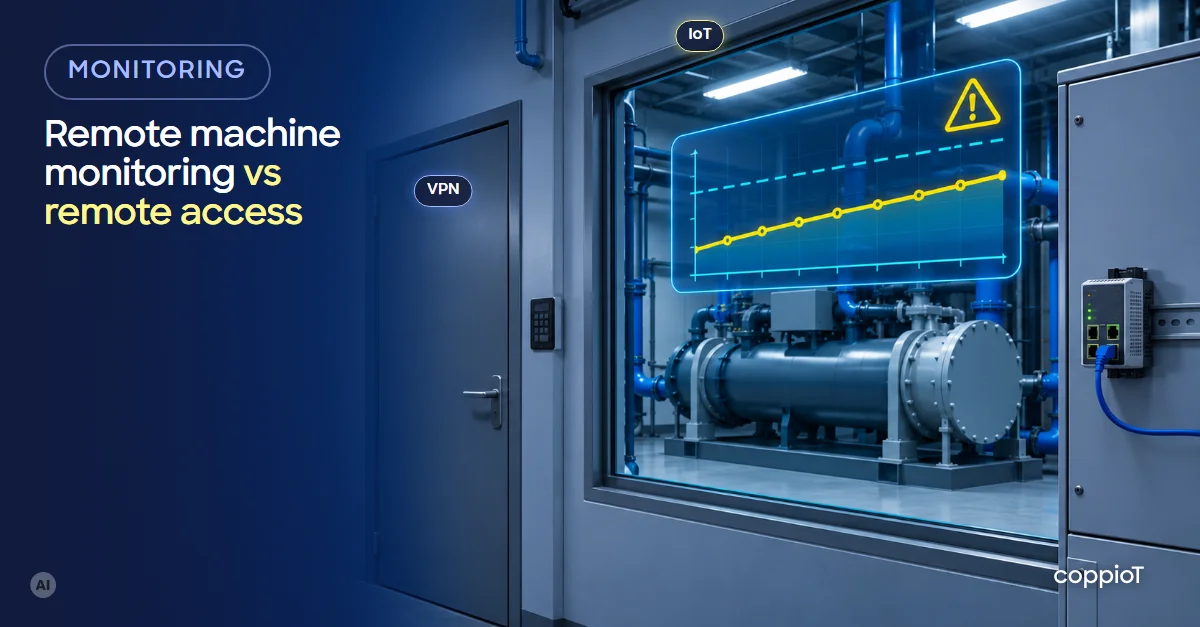
Remote access over VPN¹ is a door: a technician gets into the machine’s network when something goes wrong and analyses it as if standing next to it. Remote monitoring with IoT² is a window that is always open: it records the machine even when nobody is connected and gives production, maintenance and quality data they can understand. They aren’t the same thing, and one doesn’t replace the other: they work best together.
When many machine builders hear “connected machine”, they think of a VPN. That makes sense: for years they’ve been putting a router in the control cabinet so their service team can get in without travelling. But when a customer asks “how many parts did the machine make yesterday?” or “why did it stop last night?”, the VPN doesn’t have the answer. This article explains what each one gives you, what it doesn’t, and how they fit together.
What is remote access over VPN?
A VPN creates an encrypted tunnel between your computer and the machine’s network. Once you’re in, it’s as if you were in the plant with your laptop plugged into the cabinet.
But being on the machine’s network isn’t the same as seeing the machine. To see anything, you need one of these three things:
- The PLC³ program and its programming software, with the right licence and version.
- Access to the machine’s screen (HMI⁴), if it allows remote control.
- A web server on the machine that shows the variables.
Without one of them, the VPN can be connected and you still won’t see a single variable. That’s why remote access is a technician’s tool: someone who knows how to program the machine gets in when there’s a problem, watches the program running, works out what’s happening and fixes it. It’s how you change a parameter, help the operator or save a trip.
What it doesn’t do is keep what happened while nobody was connected. If the machine stopped at three in the morning and reset itself, the VPN has no idea.
What is remote monitoring?
Remote machine monitoring means reading a machine’s signals continuously, storing them in the cloud and showing them on a dashboard you open in a browser. It runs on its own, around the clock, whether anyone is looking or not.
That gives you four things a VPN doesn’t:
- History. You can go back to last night’s stop and see which signals changed beforehand.
- Alerts. If a temperature, a pressure or an energy reading goes out of range, an alert goes out without anyone being connected.
- Trends. Something that creeps up slowly shows weeks before an alarm goes off.
- Data that people who aren’t technicians understand. Each team sees its own, without opening the PLC program:
- production: good parts, bad parts, stops and how long they lasted;
- maintenance: running hours, temperatures, repeated alarms;
- quality: rejects and the conditions they happened in.
In industry this is called industrial IoT: a gateway in the plant reads the machine’s signals and sends them to the cloud. How coppioT works shows it step by step.
Remote access vs remote monitoring: side by side
| Remote access (VPN) | Remote monitoring (IoT) | |
|---|---|---|
| What it’s for | Getting in to analyse and fix | Seeing how the machine works, all the time |
| Who uses it | The technician who can program it | Production, maintenance, quality and the technician |
| What you need to see anything | PLC software, the HMI or a web server | A browser |
| When it works | When someone connects | Always, even when nobody is looking |
| History | No | Yes |
| Alerts | No | Yes |
| Last night’s stop | Only if the machine logged it | You see what happened before, during and after |
An example: the motor that runs hot
A motor normally runs at around 60 °C, with the alarm at 80 °C. Over two weeks it reads 70, 71, 72, 73 °C. (Illustrative example.)
- With a VPN only: nobody notices. The alarm goes off on a Friday afternoon, the machine stops, the customer calls and the technician logs in over VPN to look for the cause with the machine already down.
- With remote monitoring: the trend shows on the dashboard and an alert goes out when it passes 70 °C. Maintenance replaces the bearing or cleans the fan during a planned stop.
Why use both?
Because each one does its own part well. The usual flow is:
- IoT raises the alert: a signal goes out of range and the alert arrives.
- The technician checks the data: before connecting, they already know which signal, since when and by how much.
- The technician connects over VPN, if the program needs changing, and goes straight to what matters.
- IoT confirms that the signal is back to normal after the change.
For a machine builder, this changes how service works: fewer “it’s stopped and we don’t know why” calls and more visits that can be planned. We cover it in how IoT reduces machine downtime.
How do you set up remote monitoring without redesigning the machine?
You don’t need to change the machine’s logic; at most, you enable or configure the PLC’s communication. A gateway in the plant reads the signals the PLC already has, from any brand, and sends them to the cloud, where you build the dashboard and set up the alerts. Which signals to watch and how to set up alerts people act on is in real-time industrial monitoring.
coppioT is engapplic’s no-code industrial IoT platform: it connects machines to the cloud with no need to program. If you build machines and want to offer this service to your customers, see coppioT for machine builders. And if you’d rather have help deciding which signals to connect and where to start, engapplic does it with a short consultancy, in phases.
Frequently asked questions
What is remote monitoring?
Reading the signals of a machine or an installation continuously, storing them and showing them remotely, with history and alerts. Unlike remote access, it doesn’t need anyone to be connected.
Do I need a VPN to see my machine?
No. To see data, history and alerts, remote monitoring and a browser are enough. A VPN is still useful when a technician has to get in to change the program or analyse a fault live.
Does remote monitoring replace remote access?
No. Monitoring tells you what’s happening and what happened; remote access lets you act on it. Together, the technician gets in already knowing what to look at.
Is remote monitoring secure?
It depends on how it’s built. With coppioT, the gateway only opens outbound, encrypted connections, so there’s no need to open any inbound port on the plant’s firewall. We explain it in industrial IoT security.
Want to see your machine like this? Book a demo and we’ll show you a connected plant.
Acronyms
¹ VPN (Virtual Private Network): an encrypted tunnel to get into a network from outside.
² IoT (Internet of Things): here, industrial equipment that sends its data to the cloud.
³ PLC (Programmable Logic Controller): the controller that runs a machine or an installation.
⁴ HMI (Human-Machine Interface): the machine’s screen that the operator works with.


