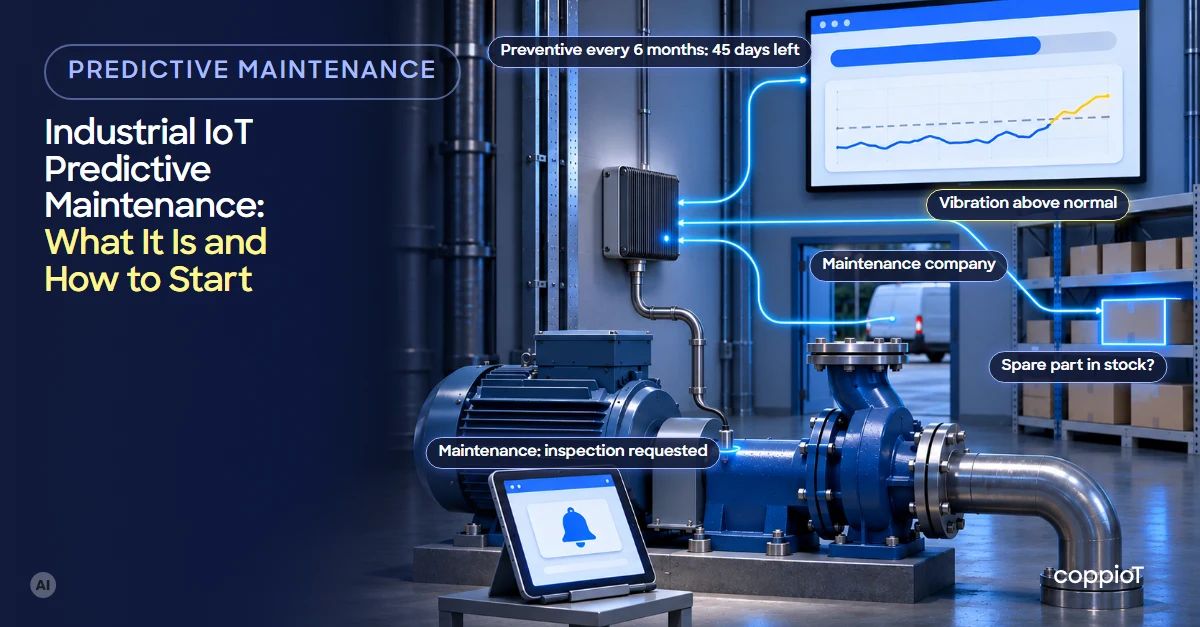
Industrial IoT¹ predictive maintenance watches how a machine signal changes while it is still within its range, and warns you before the machine fails. The repair then happens in a planned stop, not when the machine stops the line. To start, all you need is one critical machine and two or three signals that the PLC² often already has.
Corrective, preventive and predictive: what’s the difference?
| When you act | What happens | |
|---|---|---|
| Corrective | When the machine has already failed | Unplanned downtime, rush parts and the line waiting |
| Preventive | Every so often or every so many hours, whether it fails or not | Parts that were still fine get replaced, and some fail before their date |
| Predictive | When the machine data says something is starting to go wrong | The repair happens in a planned stop, with the part already ordered |
Predictive doesn’t fully replace preventive: some checks will still be done by the calendar. What changes is that, on the machines that hurt most when they stop, you stop guessing.
Which signals work for predictive maintenance?
The ones that change slowly as a part wears. Many are already in the PLC or in an energy meter, with nothing added:
- Temperature of a motor, a bearing or the oil: it rises with friction or poor cooling.
- Current or power of a motor: it rises, at the same output, when the machine is working harder.
- Pressure in a circuit: it usually drops when there’s a leak or a filter starts to fail.
- Running hours and cycles: they tell you how much each machine has really worked.
- Vibration: one of the most useful signals on motors and pumps, but it usually needs a sensor the machine doesn’t have.
The key is to compare each signal with what is normal for that machine. That’s why you need history: a few weeks of data to learn how it behaves when all is well.
How do you see a failure before it happens?
As a trend. The signal is still within its range and no alarm has gone off, but the chart shows where it’s heading. A motor that usually runs at about 60 °C and alarms at 80 °C reads 70, 71, 72 and 73 °C on consecutive days: at that rate, it will pass 80 within a week. A predictive maintenance system can warn you at that point, and the check is scheduled for the next stop.
How that turns into less downtime is in how IoT reduces machine downtime, and what to watch in each signal in real-time industrial monitoring.
How do you start with predictive maintenance?
- Pick one machine. The one that costs you most when it stops, or the one that breaks down most.
- Pick two or three signals that show its wear: for example, the temperature and current of the main motor.
- Send them to the cloud and let history build up for a few weeks.
- Look at the trends with someone who knows the machine, and set alerts where they make sense.
- Extend to other machines once the first one works.
You don’t need to start with an algorithm or with AI. Most of the value is in having the signals in view, with their history, and in someone who knows the machine looking at them.
What does coppioT do for predictive maintenance?
coppioT, the no-code industrial IoT platform by engapplic, handles the data side:
- It reads signals from the PLC over OPC UA³ or from a meter over Modbus, by choosing the values, without programming or touching the PLC program.
- It stores the history of each signal.
- It shows the trends and their projection in charts, and raises alerts when a signal moves out of the normal.
Once the data is in the cloud, we can look at taking it to your other systems: checking the ERP⁴ for a spare part for that machine in stock or on order, or notifying the company that holds your maintenance contract.
What’s coming is automating trend detection with AI, always with a person who reviews and approves what it proposes.
To get started, engapplic runs a short consultancy at a fixed price to decide which machine and which signals to watch; then a pilot on one or two machines, then the rollout.
And if you build machines?
For a machine builder, predictive maintenance is a service: warning your customer before their machine stops, instead of finding out through an urgent call. For that, the machine has to ship already connected; we explain how in IoT platform for OEMs.
Frequently asked questions
What is IoT predictive maintenance?
It’s using the data a machine sends to the cloud, such as its temperature or its power use, to see that something is starting to go wrong before it fails, and to schedule the repair.
Do I need new sensors?
Not always. Temperatures, currents, pressures, hours and cycles are often already in the PLC. Vibration is the one that most often needs a new sensor.
Do I need artificial intelligence?
Not to start. With the history and the trends in view, someone who knows the machine can already see many failures coming. AI helps when there are many machines and many signals to review.
How much history do I need?
A few weeks to learn what is normal for each signal. The longer, the better you can tell real changes from day-to-day variation.
Want to know which signals on your machines would warn you before a failure? We start with a short consultancy: tell us which machine worries you and we’ll tell you what to watch. Request a demo.
Acronyms
¹ IoT (Internet of Things): here, industrial equipment that sends its data to the cloud.
² PLC (Programmable Logic Controller): the controller that runs a machine or an installation.
³ OPC UA (Open Platform Communications Unified Architecture): an industrial communication standard for reading data from a PLC or other device securely.
⁴ ERP (Enterprise Resource Planning): the company’s management system, which holds, among other things, purchasing and stock.


