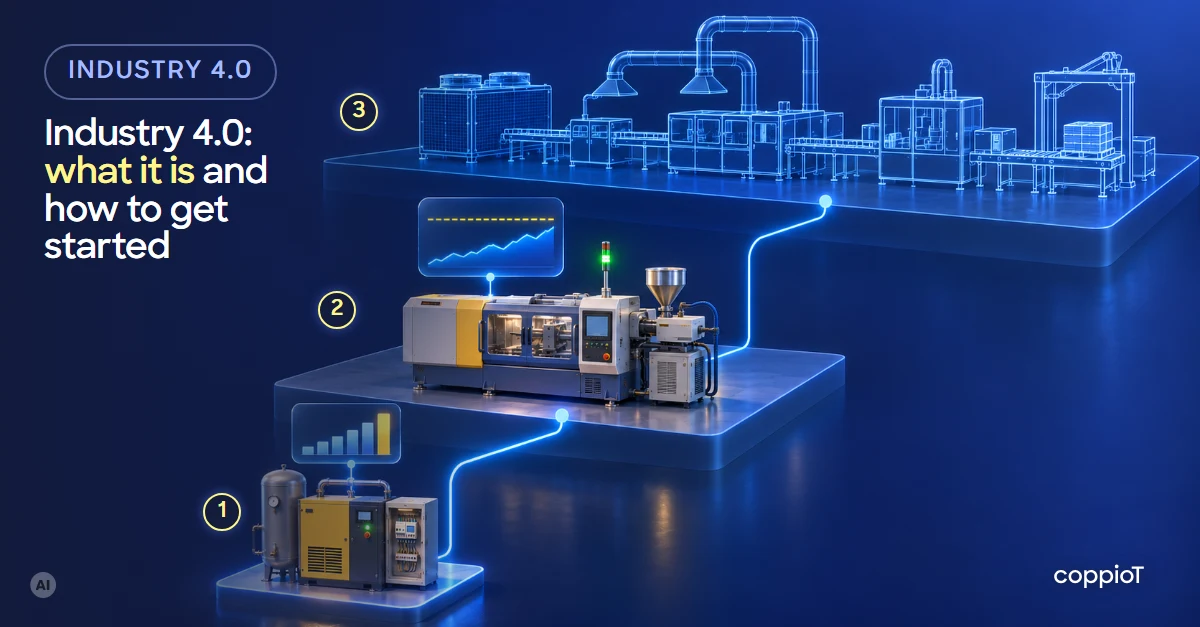
Industry 4.0 means connecting a factory’s machines and systems so the data reaches whoever decides on its own. You don’t start by buying robots or artificial intelligence, but with a small first project: one specific problem that costs money (stoppages, energy, rejects), one or two connected machines and a few weeks of data. Everything else is added on that base, when it makes sense.
What is Industry 4.0, in a few words?
The term was born in Germany in 2011 to name the fourth industrial revolution. The previous three were steam, electricity with mass production, and automation with electronics and PLCs¹. The fourth is connection: machines, sensors and management systems that share their data, so what happens on the shop floor can be seen and used outside it.
In practice, for a factory it means three things:
- See: know at any moment what each machine is doing, how much it produces and how much it uses, without anyone writing it down.
- Understand: cross that data to find out why a line stops, where the energy goes or what causes rejects.
- Get ahead: use the history to see a breakdown or a quality problem coming before it happens.
Which technologies make up Industry 4.0?
Many, but not all are needed to start, and not all depend on each other:
| Technology | What it does | When it makes sense |
|---|---|---|
| Industrial IoT² (IIoT) | Connects machines and sensors and collects their data | From the start: it’s the base for almost everything else |
| Analytics and dashboards | Turns data into indicators (OEE³, energy, stoppages) | As soon as there is data, from the first weeks |
| Predictive maintenance and AI⁴ | Spots trends and patterns to get ahead of failures | With months of history of the signals that matter |
| Digital twin | A virtual replica of a machine or line to simulate changes | In complex processes, with data already organised |
| Collaborative robots (cobots) | Robots that work alongside people | For repetitive manual tasks; doesn’t depend on the data |
| Additive manufacturing | Industrial 3D printing of parts | For prototypes, spares or short runs; doesn’t depend on the data either |
If you’re unsure where to start, the order of the table works as a guide: without machine data, analytics, AI and the digital twin have nothing to feed on. The difference between IIoT and Industry 4.0 is in what is IIoT.
Why do so many Industry 4.0 projects stall?
Almost always for one of these reasons:
- Doing everything at once: a new ERP⁵, robots, AI and digital transformation in one project. It takes years and shows no result.
- Starting from the technology, not the problem: a platform or some sensors are bought, and then a use is sought for them.
- Nobody owns the project: without someone on the shop floor pushing it, the data arrives and nobody looks at it.
- Old machines look like a wall: people assume they have to be replaced, and usually they don’t. The ways to connect them are in how to connect legacy machines to the cloud.
Where should you start?
With a problem that already costs you money and that you can’t measure well today. These are the most common for a first project:
| If your problem is… | Which data is needed | What you have in a few weeks |
|---|---|---|
| Stoppages nobody can explain | Machine state, part counter, stoppage reason | How long each machine is stopped and why; OEE without spreadsheets |
| An energy bill that keeps rising | Consumption of the building, by line or by machine, from power analysers | Where the energy goes, how much comes from the solar panels and how much from the grid, consumption with the plant stopped and cost per part |
| Auxiliary equipment that may be wasting energy (compressors, building cooling, fume extraction) | Consumption and running hours of each unit, with its pressures or temperatures | What it costs you to produce compressed air or cooling, and whether the unit runs unloaded or more than needed |
| Rejects or quality problems | Process parameters (temperatures, pressures, speeds) and rejects | Which process conditions coincide with the rejects |
| Breakdowns that come without warning | Temperatures, vibration, running hours of critical equipment | Trends nearing their limit before the alarm goes off |
Choose one, the one that weighs most on your bottom line, and start with that alone. How OEE is calculated from machine data is in how to calculate OEE in real time; where to put energy meters, in energy monitoring in manufacturing.
What does a first project look like, step by step?
- Choose the problem and the machine: one or two machines or pieces of equipment where that problem shows (an injection moulding press, a packaging line, a compressor or a chiller), and one person on the shop floor who will use the data.
- Check what the machine has: the PLC usually has the states, the counters and many temperatures; consumption data only exists if there are meters or analysers. A gateway on the shop floor reads the PLC over OPC UA⁶ or Modbus⁷. In most cases the machine’s logic doesn’t change. At most, the PLC’s communication is enabled or configured, or a few signals are wired in the cabinet.
- Connect and organise the data like the plant (Plant › Line › Machine), so you can compare later.
- Look at the data for a few weeks with whoever will use it: something you couldn’t see almost always shows up, such as a recurring stoppage or consumption with the plant stopped.
- Measure the result and decide: if the first project brought a saving or an improvement, that’s the case for taking it to more machines. If not, you’ve learned at little cost.
AI and predictive maintenance come later, once there are months of history of the signals that matter.
How we do it with coppioT
coppioT is engapplic’s no-code industrial IoT platform: it connects PLCs, sensors, energy analysers and other equipment of any brand to the cloud, in one data system and with no programming. Your charts and reports go in the tools you already know, Grafana or Power BI, with the data already organised like your plant.
- A short consultancy at a fixed price, with engapplic: which problem you want to solve, what your machines have and which data is needed.
- A pilot on one or two machines: we connect them and review the first data with you.
- Scaling to the rest of the plant, or to other plants, with the same structure.
That’s what we did on the paint booth we have connected at a RACC-AXA car workshop in Barcelona, with the integrator Sinnek: the customer sees what the diesel or LPG⁸ and the electricity cost, and the cost per part and per hour.
All of that in days, not months: up to 90% faster than building it by hand.
Frequently asked questions
How much does it cost to get started with Industry 4.0?
It depends on what you want to achieve and what your machines have, but a first project on one or two machines isn’t a full digital-transformation investment. That’s why it pays to start with a contained pilot and decide based on its results.
Do I have to replace my old machines?
Hardly ever. If the machine has a PLC, it can usually be read; if not, its signals can be taken in the cabinet or a sensor added. What you can’t do is get data the machine doesn’t measure.
Do I need an IT team?
Not to start. With a no-code platform, connecting and organising the data requires no programming. You do need someone on the shop floor who knows the machines and will use the data.
Is Industry 4.0 the same as IIoT?
No. Industry 4.0 is the whole shift towards a digital factory, with many technologies. IIoT is the part that connects the machines and collects their data, and it’s usually the first step.
How long does a first project take?
Connecting the first machines takes days. After that, you need a few weeks of data to draw useful conclusions.
Want to take the first step with your machines? Ask for a demo: fill in the form, tell us which problem you want to solve and which machines and PLCs you have, and we’ll show you how we would start.
Acronyms
¹ PLC (Programmable Logic Controller): the controller that runs the machine; for example, a Siemens S7 or a Beckhoff.
² IoT (Internet of Things): industrial IoT (IIoT) connects machines and plant equipment to collect their data and use it.
³ OEE (Overall Equipment Effectiveness): availability, performance and quality combined into a single percentage.
⁴ AI: artificial intelligence; here, models that learn from historical data to spot patterns.
⁵ ERP (Enterprise Resource Planning): the company’s management system (orders, purchasing, stock, invoicing).
⁶ OPC UA (Open Platform Communications Unified Architecture): an industrial communication standard to read data from a PLC or other device securely, with its name and type.
⁷ Modbus: a simple, widespread industrial protocol (RTU over a serial line, TCP over Ethernet). Data is read from numbered registers, following the map the device maker provides.
⁸ LPG (Liquefied Petroleum Gas): propane or butane, a common fuel for burners and paint booths.


