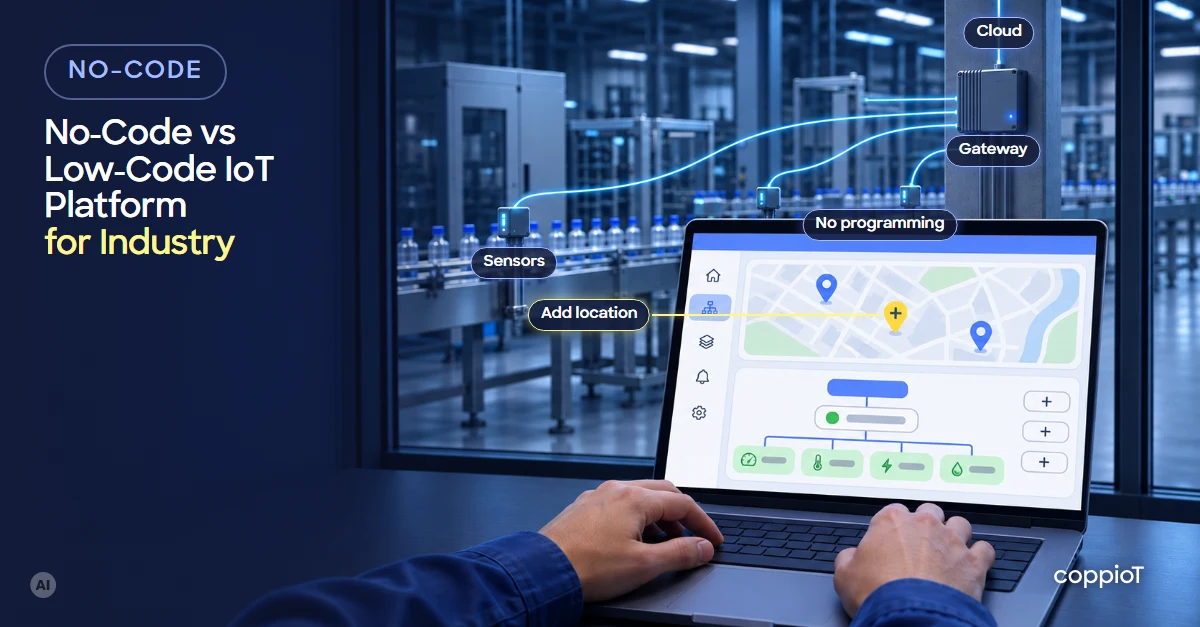
A low-code IoT¹ platform cuts the code, but it still expects someone to write some: scripts, data parsers, rules. A no-code industrial IoT platform takes you from a PLC² or an energy meter to the cloud by choosing values, with no programming needed, so a controls engineer can run the project without a developer. coppioT, the no-code industrial IoT platform by engapplic, works the second way.
What does “no-code” mean in industrial IoT?
In a factory, “no-code” has to mean more than a drag-and-drop dashboard. It has to cover the hard part: getting the data out of the machines. With coppioT, that looks like this:
- Describe the plant in a web app: the site, the lines and the machines, with your own names.
- Add each device and pick the values you want: from a PLC through its OPC UA³ server, or from an energy meter over Modbus.
- Install the gateway. coppioT generates the installation files. On our gateway, available on request, they install themselves as soon as it has internet access; on a PC at the site, you install them by hand. The gateway only connects out, so there’s no inbound port to open; more in industrial IoT security.
- Deploy with one click. The cloud is set up to match the plant, and the readings start to flow.
- Use the data: charts of each value, and on top of them dashboards, KPIs⁴, costs and alerts.
Nobody writes a line of code in any of those steps. You don’t redesign the machine or change the PLC program either.
We’re working on a gateway that installs itself on any device. If you’re interested, write to us and we’ll let you know as soon as it’s available.
Low-code vs no-code vs building it yourself
Looking for a low-code industrial IoT platform? coppioT is no-code: no programming needed. This is how the three options compare for an industrial project:
| Build it yourself (e.g. on AWS⁵) | Low-code IoT platform | No-code industrial IoT platform | |
|---|---|---|---|
| Who does the work | Developers and a cloud architect | A developer plus a controls engineer | A controls engineer or integrator |
| What you write | Everything: connectors, backend, dashboards | Scripts, parsers, rules | Nothing: you choose values |
| The field side (gateway, PLC) | You build or buy it | Often left to you: connectors, but no connection | Included, end to end |
| What you maintain | All of it | The scripts and the glue | The plant model |
| Typical fit | Large teams, very custom needs | Makers and projects led by software teams | Machine builders, integrators, plants |
The row that matters most is the field side. Many low-code platforms don’t cover the whole vertical: they offer connectors, but the connection itself is yours to make. The gateway, the field and the script that turns OPC UA into MQTT⁶ are left to you. coppioT covers the whole vertical, from the PLC and the gateway at the site to the cloud and the dashboards.
The first column is how we used to do it at engapplic. The same kind of project done with coppioT is up to 90 % faster: days instead of months, measured against our own hand-built AWS IoT projects.
Which machines can a no-code platform read?
It depends on how each device communicates, not on its brand. coppioT works with equipment of any brand:
- PLCs, through their OPC UA server, such as Siemens S7-1200 and S7-1500 or Beckhoff with TwinCAT 3. OPC UA is the open standard of the OPC Foundation for exchanging industrial data securely.
- Energy meters and many machines, over Modbus, the protocol maintained by the Modbus Organization.
- Analog signals and pulse counters, with our gateway.
If your device uses another protocol, tell us and we’ll look at how to read it. If you’re choosing between the first two, we compared them in Modbus vs OPC UA.
What does it cost?
Before you deploy, coppioT estimates the monthly cost of the project, so the cost is known before you start. It runs on AWS, so it works worldwide.
And AI?
coppioT also works with AI assistants such as Claude. The assistant does what the web app does, as you and with your permissions: give it the PDF manual of a device and it sets the device up for you. It’s the same no-code idea, one step further: you describe what you want in plain words.
Is no-code enough for a real plant?
Yes, if your team has technicians who know the machine: which signals matter and which alarms to watch. With that, you can run coppioT yourselves, from the PLC values to the dashboards, without programming. What to watch is covered in real-time industrial monitoring, and how to build a dashboard people use in industrial dashboards.
If you need help, we provide it. engapplic starts with a short consultancy at a fixed price to decide what to measure, then a pilot on one or two machines, then the rollout.
Frequently asked questions
Is a no-code IoT platform the same as a low-code IoT platform?
No. Low-code reduces the code you write but still expects some: scripts, parsers or rules, and often the gateway and field side too. No-code means configuring, not programming: you pick the values to read and deploy.
Can a no-code IoT platform read Siemens PLCs?
Yes, if the PLC has an OPC UA server, as the S7-1200 and S7-1500 do. coppioT reads the values you choose by their OPC UA path. Beckhoff with TwinCAT 3 works the same way.
Do I need to change the PLC program?
No. coppioT reads the values the PLC already has, so the machine doesn’t need to be redesigned.
How much does an industrial IoT platform cost?
It depends on the number of values and how often they’re read. coppioT estimates the monthly cost of each project before you deploy it, so you know it before you start.
What is IIoT?
IIoT⁷ means taking the data from a plant’s machines, PLCs and sensors to a system where it can be seen and analysed, usually in the cloud. We explain it in what is IIoT.
Want to see it with your own machines? In a demo we build a sample plant live, with a PLC and energy meters sending their data to the cloud, without writing code. Request a demo.
Acronyms
¹ IoT (Internet of Things): here, industrial equipment that sends its data to the cloud.
² PLC (Programmable Logic Controller): the controller that runs a machine or an installation.
³ OPC UA (Open Platform Communications Unified Architecture): an industrial communication standard for reading data from a PLC or other device securely.
⁴ KPI (Key Performance Indicator): a figure that tells you how something is going, such as energy per part.
⁵ AWS (Amazon Web Services): Amazon’s cloud, which coppioT runs on.
⁶ MQTT (Message Queuing Telemetry Transport): a lightweight protocol for sending device data to the cloud.
⁷ IIoT (Industrial Internet of Things): IoT applied to machines and plants.


