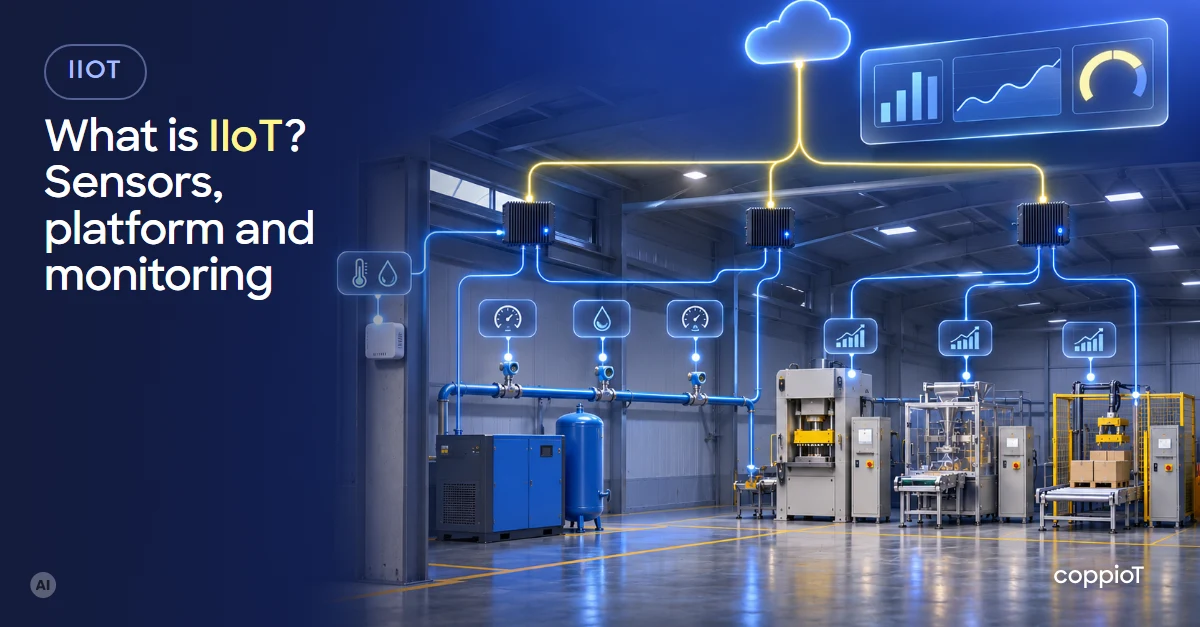
IIoT¹, the Industrial Internet of Things, means connecting a plant’s machines, PLCs² and sensors to collect their data and use it: see what is happening in real time, keep the history and get an alert when something goes out of range. An IIoT system has four parts: the devices that measure, a gateway that reads them, a platform that stores and calculates, and the dashboards and alerts people use.
What does IIoT stand for?
IIoT stands for Industrial Internet of Things: the industrial side of the IoT³, the Internet of Things. The US National Institute of Standards and Technology, in its guide to operational technology security, describes it as sensors, instruments, machines and other devices networked together that use internet connectivity to improve industrial and manufacturing processes.
On the shop floor: a press, an oven or a packaging line already produces data all day (whether it’s running, how many parts it makes, what temperature it runs at, how much energy it uses), but that data stays in the PLC and on the machine’s screen. IIoT gets it out, stores it and puts it in front of whoever has to decide.
It helps to be clear about what isn’t there before you start: the PLC holds current values, not the history. The history starts the day you connect the machine.
How is IIoT different from IoT?
The underlying technology is the same; what changes is where it’s used and what happens when it fails.
| Consumer IoT | IIoT | |
|---|---|---|
| Devices | Thermostats, watches, home appliances | PLCs, energy meters, sensors, machines |
| How long they last | A few years | Ten, fifteen years or more, and they aren’t replaced just to connect them |
| How they communicate | Wi-Fi and the maker’s app | Industrial protocols: OPC UA⁴, Modbus⁵ and others |
| If it fails | An annoyance | A stopped line, a bad part or a safety issue |
| The network | The home network | The plant network, managed by your company’s network team |
The same guide puts a typical office computer system’s life at 3 to 5 years and an industrial control system’s at often 10 to 15 years or longer. That’s why an IIoT system has to read devices of many brands and ages, survive network drops without losing data and never put the machine’s control at risk.
How does an IIoT system work?
- The devices that measure. Each machine’s PLC, which already knows whether it’s running, how many parts it has made and which alarm is active; the energy meters in the electrical cabinet; and, when needed, an added sensor.
- The gateway on the shop floor. Software on a PC in the plant that reads those devices over OPC UA, Modbus or other protocols, filters the data and sends it to the cloud. If the internet connection drops, it keeps the data for about 1 or 2 days and sends it when the connection is back.
- The IIoT platform in the cloud. It stores the history, calculates the KPIs⁶ (parts per hour, stops, energy per part) and raises alerts when a value goes out of range.
- The dashboards and alerts. What people see: production, maintenance, management. A dashboard per line or per plant and an alert when something isn’t right.
In most cases the machine’s logic doesn’t change. At most, the PLC’s communication is enabled or configured, or a few signals are wired in the cabinet.
Which IIoT sensors do you need?
Fewer than you’d think. Start by reading what already exists: a modern machine’s PLC has states, counters, temperatures and alarms, and many energy meters already have a Modbus output. New sensors are added only when the data you want isn’t in the machine:
- Energy use: an energy meter in the cabinet, with current transformers that clip around the cable without cutting it.
- Motor vibration or temperature: a sensor bolted or glued to the housing, with a 4–20 mA or Modbus output.
- Flow or pressure: a flow meter or a pressure transmitter with an analogue output.
- Parts or run and stop, on machines whose PLC doesn’t communicate: the signal in the cabinet, to a pulse counter or an input module.
If the machine is old, there are three ways to connect it depending on what it has; we explain them in how to connect legacy machines to the cloud.
What is IIoT monitoring used for in a factory?
- Real-time monitoring: see which machines are running, stopped or in alarm, from the office or your phone. We cover it in real-time industrial monitoring.
- OEE⁷ without spreadsheets: availability, performance and quality calculated automatically from the machine’s signals. We explain it in real-time OEE.
- Energy: energy per part, idle consumption and peak demand, by matching the meters with what each machine produces.
- Getting ahead of failures: a motor that usually runs at about 60 °C, with its alarm at 80 °C, reads 70, 71, 72 and 73 °C on consecutive days. No alarm has gone off yet, but the trend says it will pass 80 within a week. A predictive maintenance system can warn you before that (an illustrative example).
What is an IIoT platform and what should you look for?
The IIoT platform is the part of the system that receives the data, stores it and turns it into dashboards and alerts. When comparing platforms, these are the questions worth asking:
| Question | Why it matters |
|---|---|
| Does it read my devices, of any brand? | A plant mixes PLCs, meters and machines from different makers and decades |
| Does it also cover the shop floor? | Many platforms give you the cloud but leave the field connection (the gateway, getting from OPC UA to the cloud) to you |
| Do I need to write code? | If every new machine is a development project, it won’t scale |
| What happens if the internet drops? | The gateway must keep the data and send it later |
| Can I start with one or two machines? | A small pilot tells you more than a presentation |
How we do it with coppioT
coppioT is engapplic’s no-code industrial IoT platform: it connects PLCs, controllers, energy analysers and other equipment of any brand to the cloud, with no programming. It covers the whole vertical: from the PLC and the gateway on the shop floor to the cloud and the dashboards.
- We look at your machines with you: what you want to know and what each one has to give you that.
- We connect them over OPC UA, Modbus RTU or TCP, analogue inputs or pulse counter, through a gateway whose installation files coppioT generates. coppioT is compatible with any PC or industrial PC; if you prefer, our gateway, available on request, comes with analogue inputs and a pulse counter.
- We build the dashboard with you in Grafana or Power BI, with the alerts you need.
That’s what we did on the paint booth we have connected at a RACC-AXA car workshop in Barcelona, with the integrator Sinnek: the customer sees what the fuel and the electricity cost, and the cost per part and per hour.
All of that in days, not months: up to 90% faster than building it by hand. We start with a short consultancy at a fixed price with engapplic and a pilot on one or two machines before scaling.
Frequently asked questions
What does IIoT mean?
Industrial Internet of Things: connecting a plant’s machines, PLCs and sensors to collect their data, store it and use it to produce better.
Is IIoT the same as Industry 4.0?
No. Industry 4.0 is the whole shift towards a digital factory, with many technologies (robotics, simulation, artificial intelligence, IIoT…). IIoT is the part that connects the machines and collects their data, and it’s usually the first step.
Do you need to replace machines to use IIoT?
No. The PLC is read if it communicates, its signals are read in the cabinet if it doesn’t, or a meter or a sensor is added. The machine’s logic doesn’t change.
Is it safe to connect machines to the internet?
It’s a fair concern. With coppioT the machines aren’t opened to the internet: the gateway only makes outbound connections and no inbound port has to be opened. We explain it in industrial IoT security.
Want to know what data you could get from your machines? Ask for a demo: fill in the form, tell us which machines you have and we’ll show you how it would look.
Acronyms
¹ IIoT (Industrial Internet of Things): the part of the Internet of Things that connects industrial machines and equipment.
² PLC (Programmable Logic Controller): the controller that runs the machine; for example, a Siemens S7 or a Beckhoff.
³ IoT (Internet of Things): objects and devices connected to the internet that send their data.
⁴ OPC UA (Open Platform Communications Unified Architecture): an industrial communication standard to read data from a PLC or other device securely, with its name and type.
⁵ Modbus: a simple, widespread industrial protocol (RTU over a serial line, TCP over Ethernet). Data is read from numbered registers, following the map the device maker provides.
⁶ KPI (Key Performance Indicator): a number that tells you whether a process is going well, compared with a target or with its history.
⁷ OEE (Overall Equipment Effectiveness): multiplies a machine’s availability, performance and quality.


